Plan your business card
Practise business-card design decisions using your existing logo and card ideas. Letterhead development belongs to the summative.
For this lesson
One brand, three business-card directions
Compare three front-and-back pairs using the same logo, name and fictional contact details. Notice how layout, colour and negative space change the first impression. Each option includes a benefit and a limitation.
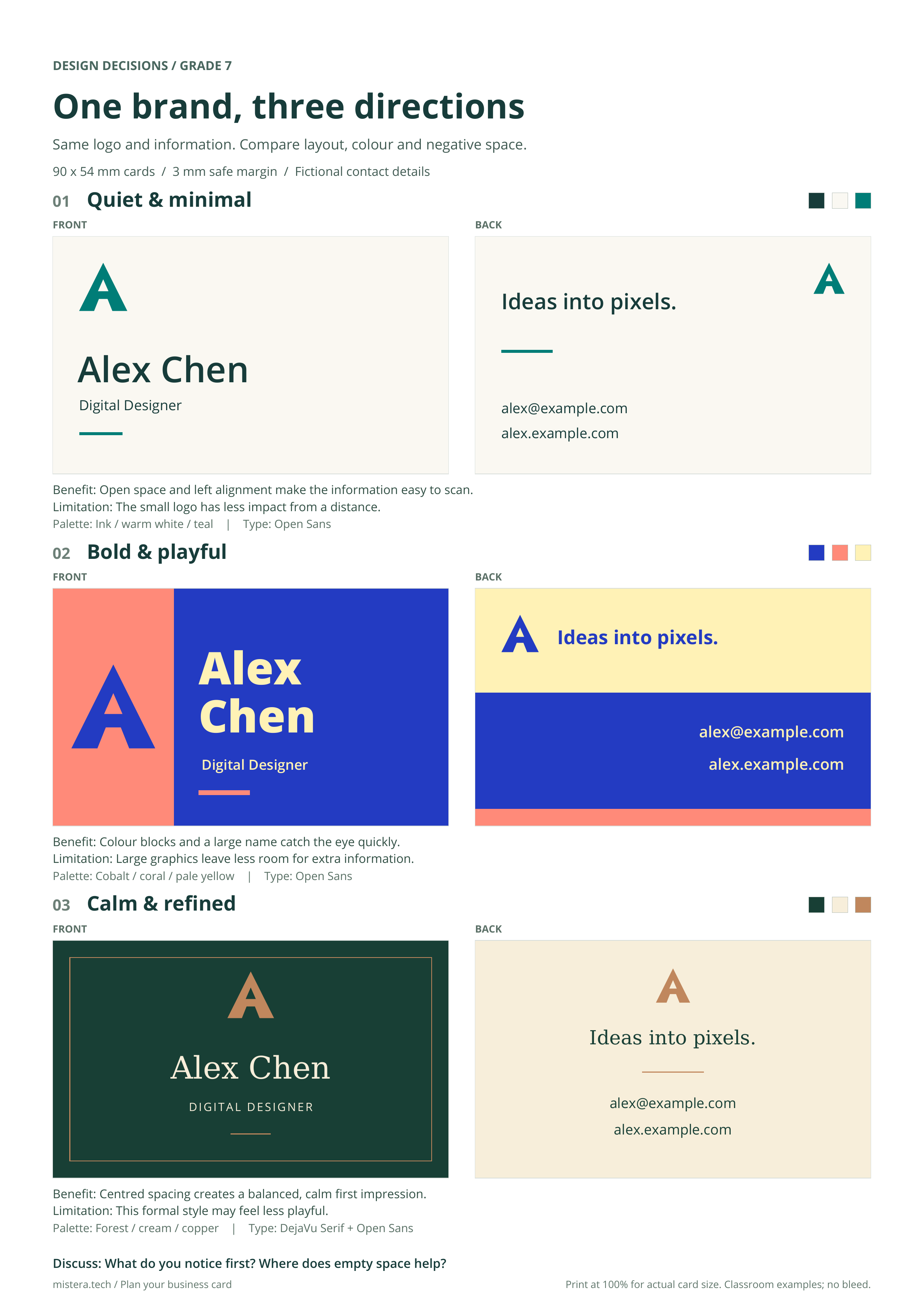
Discuss: What do you notice first? Where does empty space help? Use the comparison to explain your own design decisions.
Reuse the card. Make one letterhead.
Reuse Research your brand audience (Worksheet 1) and Plan your business card (Worksheet 2). Keep the existing research, three card alternatives, chosen card, and labeled card plan. Do not make replacement cards or three new letterhead designs.
Due Monday, October 19, 2026 at 20:00 China time.
Keep the practice evidence and feedback. The final task adds one coordinated letterhead and a small labeled plan, not another set of cards or a new report.
Practise business-card design decisions using your existing logo and card ideas. Letterhead development belongs to the summative.
Formative practice due 12 October. Bring your current logo, business-card designs and research. Reuse completed alternatives and plans, act on feedback and fill gaps. Do not restart the card or produce letterheads for this worksheet.
Work through the sheet
Write in the editable handout or on the printed sheet. Add labelled sketches, screenshots or extra pages when you need them.
- 01
Write success requirements
Review four checkable requirements for your business card, linked to research. Keep suitable existing requirements. For example, the logo stays clear at card size and fictional contact text is readable. Say how you would check each; no letterhead requirement is needed yet.
Keep: Four requirements with research links and a way to check each.
- 02
Draw three alternatives
Show three meaningfully different business-card directions using your existing logo. Reuse the alternatives you have already made; add only what is missing. Label a user benefit and a practical limitation for each. Keep these directions for the summative: do not make three replacement cards.
Keep: Three labelled sketches; add a separate page if needed.
- 03
Present your choice
Present your existing or refined card choice. Explain an advantage, a trade-off and a genuine response to feedback. Keep earlier evidence with its original date; do not invent changes or rewrite an adequate explanation.
Keep: Chosen sketch and a reasoned decision.
- 04
Make the planning drawings
Use or complete a labelled business-card plan: dimensions, safe margins, logo, fictional contact text, colours and type. Keep an adequate existing drawing and its file or page reference. Add missing labels and a short resource list. No letterhead drawing is required for practice.
Keep: Labelled drawings or diagrams attached to this sheet.
Grading rubric · 8 points
Formative feedback: four evidence rows, each worth 0, 1 or 2 points (8 total). Existing evidence counts when clearly located. Use feedback to improve the final submission; these practice points are not the summative A/B levels. A row earns zero when no relevant evidence is shown.
| Evidence | 1 point | 2 points |
|---|---|---|
| Write success requirements | Requirements are mostly preferences or cannot be checked. | Requirements cover the project need and include a practical way to check success. |
| Draw three alternatives | Shows a limited set of ideas or differences are mainly cosmetic. | Shows three feasible alternatives with meaningful differences that can be understood. |
| Present your choice | Chooses a design but gives limited reasons or does not acknowledge a trade-off. | Presents the choice with evidence, a relevant trade-off and an explained refinement. |
| Make the planning drawings | Drawings show the idea but key labels or relationships are missing. | Drawings clearly communicate the chosen design and the details needed to interpret it. |
What to submit
Submit this worksheet with your existing or refined business-card alternatives, choice and labelled plan to the practice assignment in Toddle by 12 October. Include relevant card files or evidence references, sources and an AI-use record. No letterhead or full final brand-system bundle is required.
AI-generated designs are allowed. Keep your actual prompts in chronological order with matching versions or screenshots that show progressive changes. Briefly explain why you changed the design and what you checked: readability, accuracy and brand coherence. Use a short existing record, not a new essay. If unused, write "No AI used". Use fictional contacts; do not share private personal data.
Open Toddle →Related assignments
- Plan your business card
Formative practice due 12 October. Bring your current logo, business-card designs and research. Reuse completed alternatives and plans, act on feedback and fill gaps. Do not restart the card or produce letterheads for this worksheet.
Assignment on the calendar →
Submit in Toddle. The assignment instructions above specify what to hand in.