Student library
Handouts & slides
Choose your grade, then open the editable handout for your lesson. Some visual examples and class slides are currently available only as PDFs.
Grade 6 · Personal identity poster
Class home →Current summative assessment
Personal identity poster assessment
Bring your research and design decisions together for an A4 personal identity poster. Build on the work you have already completed.
Use your research and design worksheets to support the current summative assessment.
Preparation and summative
Each preparation sheet has its rubric at the end. The summative has separate A and B rubrics.
Handouts from lessons so far
What should my poster say about me?
Choose what you want your poster to communicate, investigate examples, and write the requirements that will guide your design.
Layout Lab: three poster sketches
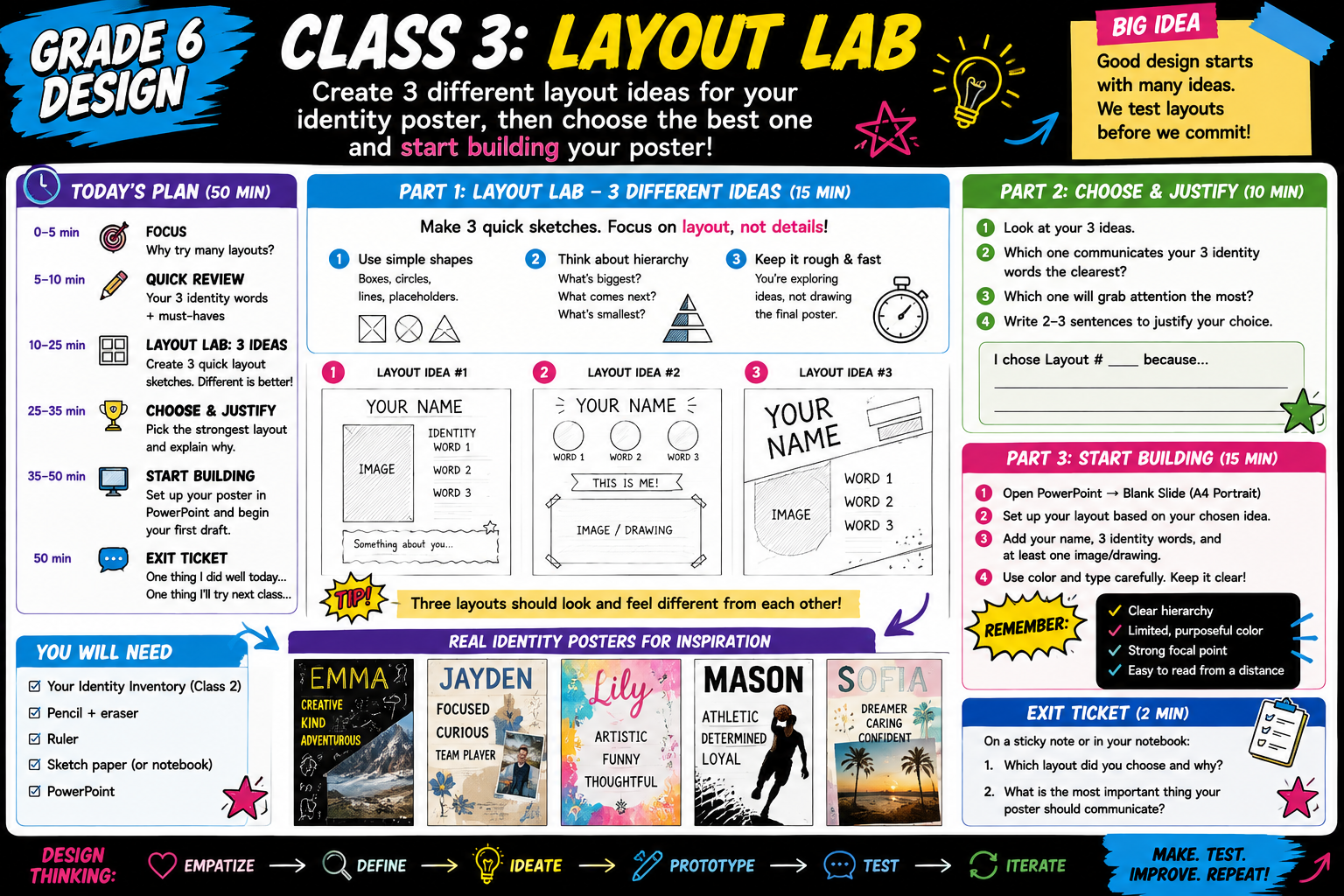
Explore three different arrangements, then explain which layout communicates your identity most clearly.
Personal identity poster: Draft 1
Turn your layout ideas into a first digital poster, then test how clearly it communicates your identity.
Build a clear digital poster
Choose a thumbnail, build a clear visual hierarchy and save an editable poster draft.
Personal identity poster: Draft 1 · class slides
Earlier handouts & later units
Earlier guides and later-unit resources. Use the project plan above for the current assessment.
- Poster research and design brief
- Poster specification and final plan
- Personal identity poster assessment
- Game research and design opportunity
- Game rules and component plan
- Build your first game prototype
- Playtest and collect evidence
- Revise your game prototype
- Final game build plan
- Paper game assessment
Grade 7 · Personal brand system
Class home →Current summative assessment
Personal brand system assessment
Keep your existing logo and chosen business card. Make one coordinated A4 letterhead that uses the same brand style and leaves room for a real letter.
Reuse the two existing worksheets as supporting evidence for the final product.
Preparation and summative
Each preparation sheet has its rubric at the end. The summative has separate A and B rubrics.
Handouts from lessons so far
Brand systems
Investigate how repeated choices in colour, type and imagery create a recognizable brand.
From mood board to logo ideas
Turn your identity words into a brief and three different logo concepts.
Digital logo build: make, simplify, change
Build your chosen logo digitally, develop two meaningful variations, and test which works best.
Final logo refinement and mini brand guide
Refine your strongest logo and record the colours, type and variations that make your brand consistent.
Earlier handouts & later units
Earlier guides and later-unit resources. Use the project plan above for the current assessment.
- Business card design
Grade 8 · Personal website
Class home →Current summative assessment
Personal website assessment
Improve your existing personal website using the home-page design chosen in Worksheet 2. Make it useful for the audience you researched. Keep the content and files that already work; one HTML page with linked sections is enough.
Reuse the two existing worksheets as supporting evidence for the final product.
Preparation and summative
Each preparation sheet has its rubric at the end. The summative has separate A and B rubrics.
Handouts from lessons so far
My personal website project brief
Decide why your website exists and what visitors should be able to understand or do. Use those decisions to direct AI.
Build from your brief
Direct AI to develop your existing website, then test and revise its output against your brief.
Website V2: clean it up
Make your website consistent, remove unnecessary elements and use a five-second test to guide a revision.
Grade 9 · Portfolio design
Class home →Current summative assessment
Portfolio design assessment
Build one improved Project Detail page using the design you chose in Worksheet 2. Keep your existing portfolio and navigation. Show one real project clearly; you do not need a new whole website.
Reuse the two existing worksheets as supporting evidence for the final webpage.
Preparation and summative
Each preparation sheet has its rubric at the end. The summative has separate A and B rubrics.
Handouts from lessons so far
Portfolio autopsy
Analyse an existing portfolio and identify what helps or confuses its users.
Research planning and user interviews
Plan useful research and ask users questions that can inform your portfolio.
AI portfolio prototype sprint
Build a clear journey through your HTML portfolio, test it with another student, and use what you observe to improve it.
Portfolio V2: one coherent design
Refine your portfolio’s design rules, hierarchy and navigation, then test it with a user.
Research planning and user interviews · class slides
Earlier handouts & later units
Earlier guides and later-unit resources. Use the project plan above for the current assessment.
- Map the whole system
- Multimeter skills
- Battery safety and fuses
- Set up the LM2596 converter
- Power the ESP32 externally
- Measure temperature with a DS18B20
- Measure electrical conductivity
- Turbidity and voltage dividers
- Integrate three sensors
- Record CSV data and timestamps
- Run a controlled water test
- Reliability and calibration
- Assemble the final system
- Demonstrate and evaluate the system
Grade 10 · Connected devices
Class home →Current summative assessment
Connected devices assessment
Part B update: four requirements, two possible solutions, and one justified choice. Reuse existing research. No planning drawings are required.
Use your research and design worksheets to support the current summative assessment.
Preparation and summative
Each preparation sheet has its rubric at the end. The summative has separate A and B rubrics.
Handouts from lessons so far
IoT product autopsy: find a real problem
Investigate connected products, their dependencies and failures, then identify a school problem worth exploring.
Set up your ESP32 and blink an LED
Connect the classroom ESP32 to Arduino IDE, prove that it runs your code, and control an external LED.
LED signals
Create slow, faster and double-flash signals, explain the delays, and revise a pattern using partner feedback.
One LED, three messages
Turn your working LED into a clear status indicator. Build three signals, test whether a partner can recognize them, and improve one using evidence.